

From Footfall to Financial Impact: How Malls Can Finally Connect Traffic and Leasing Intelligence

Shopping malls today sit on a mountain of data, footfall counts, tenant sales, Gross Turnover (GTO) declarations, rental rates, occupancy levels, demographics, dwell time, and more.
Yet despite this abundance, leasing teams still struggle with one fundamental challenge: the data doesn’t talk to each other. Footfall lives in one system, leasing in another, GTO in spreadsheets, and tenant performance in yet another silo.
The result is a familiar story across the retail property industry: decisions made on gut feel, renewals justified by brand reputation rather than contribution, and rental adjustments that lack the evidence needed to convince tenants.
But this is changing. With Skywave providing the traffic truth and ServeDeck delivering the leasing truth, malls can finally connect the dots and start transforming raw data into a strategic asset generating real financial impact.
The Silent Problem: Data Exists, But It’s Disconnected
Most malls already invest in people counting systems, leasing software, CRM tools, and tenant management platforms. The issue is the lack of data management and integration between departments.
Footfall data tells you how many people enter a zone, but not whether the tenants there are converting that traffic into revenue. GTO data shows how much tenants earn, but not whether their location is helping or hurting performance. Rental data shows what tenants pay, but not whether the rate is justified by actual shopper behavior.
When these datasets remain isolated, leasing teams are forced to rely on experience and intuition. While experience is valuable, it cannot replace evidence especially when tenants increasingly demand transparency and asset owners expect data‑driven decisions towards better yields.
Why Footfall Alone Isn’t Enough
Footfall is one of the most powerful indicators of mall performance, but only when interpreted in context and connected to other strategic datasets. High traffic doesn’t automatically mean high sales, and low traffic doesn’t always mean poor performance!
A zone with 50,000 monthly visitors may underperform if the tenant mix is wrong. A quieter zone may outperform expectations if it attracts high‑intent shoppers with longer dwell times.
This is why many malls struggle to extract value from people counting systems. Without connecting footfall to leasing outcomes, and GTO, the data remains descriptive and not actionable!
The Missing Link: Connecting Traffic Data to Leasing Intelligence
A recently signed collaboration between ServeDeck and Skywave is now bringing The Solution to close this industry‑wide gap and provide management team with real-time and aggregated data to define the malls’ future strategies, tenant-mix, leasing rates, and more!
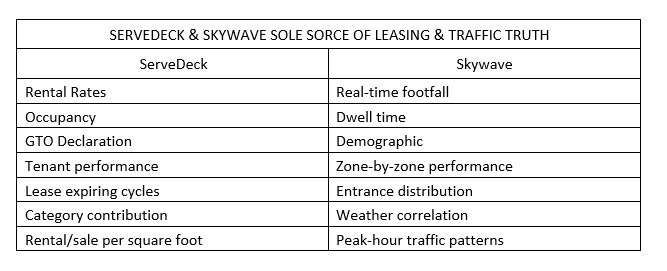
When these two intelligence layers are unified, malls finally gain a single source of truth that connects traffic to behavior, to revenue, and to rental.
This is the foundation of modern, data‑driven mall management.
Case Study 1: Underpriced High‑Traffic Zones
One of the most striking insights from the Skywave dashboards is the mismatch between traffic and rental rates. In many malls, the highest‑traffic zones are not the highest‑priced zones!
This happens because leasing teams often lack real evidence to justify lease increase. Without traffic data, it’s difficult to prove that a zone deserves a premium.
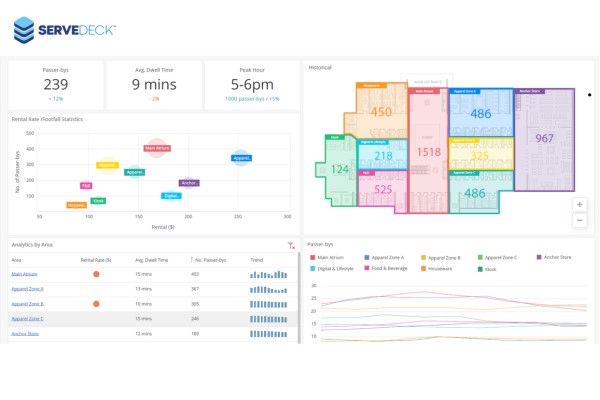
When Skywave’s footfall data is layered onto ServeDeck’s rental and occupancy data, instead, underpriced zones become immediately visible and a graphic representation showing the data outcome will become the best “convincing argument” for leasing teams to gain confidence during renewal negotiations.
Tenants will possibly understand the justification because it’s backed by data and will have no argument to request for lower rates. At the end of the chain, owners will optimise yield without guesswork, and the management team will enjoy less stressful lease renewal times.
This transforms rental adjustments from subjective discussions into objective and data‑supported decisions.
Case Study 2: Renewal Decisions Based on Impact, Not Brand Reputation
Renewal decisions are often influenced by brand familiarity or internal bias. A well‑known brand may be renewed simply because it “feels” important to have it in a specific location, even if its actual contribution is low.
The image below is a clear examples where high‑traffic zones had low‑performing tenant while lower‑traffic zones had high GTO performers. Furthermore, some tenants benefited from prime locations without delivering proportional returns!
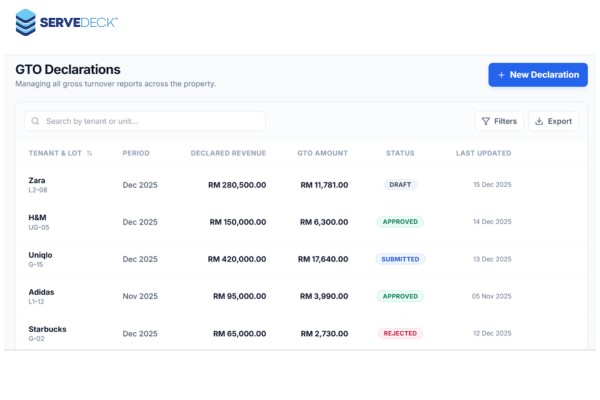
When footfall, GTO, and rental data are viewed together, leasing teams can finally evaluate tenants based on real impact, not “brand perception”. This allows the leasing team to hold stronger negotiation positions, propose more accurate rental structures, build better long‑term tenant mix, and have reduced dependency on brand prestige!
In short, renewals become data-based strategic decisions and no longer emotional.
Case Study 3: Tenant Mix Optimisation
Tenant mix is one of the most powerful levers in mall performance, yet it is often planned using intuition rather than evidence. The ServeDeck/Skywave integration highlights mismatches such as youth‑heavy traffic zones with few youth‑oriented brands, high dwell‑time zones with insufficient F&B presence, and high‑income demographic zones with low‑value tenants.

With a data supported analysis from the unified intelligence, malls’ management team can reposition tenants based on real shopper behaviors, strengthen anchor‑supporting zones, improve cross‑floor traffic flow, and plan long‑term leasing strategies with more confidence!
This is how tenant mix optimisation powered by data should happen and not as it is done today, mostly based on guesswork.
Why This Matters Now
The retail landscape is evolving rapidly and malls management/leasing team can no longer afford to make decisions based on instinct alone. Every rental rate, every renewal, every placement must be justified with evidence.
The era of “gut feel leasing” is ending. The malls that embrace connected intelligence will lead the next decade of retail!
The ServeDeck + Skywave “Unfair Advantage”
Together, ServeDeck and Skywave create a unified intelligence layer that connects operational data with traffic insights. This gives malls a complete picture of how shoppers move, how tenants perform, and how rental should be structured.
It becomes possible to see which zones deserve premium pricing, which tenants are underperforming relative to their location, which categories need strengthening, and where the next leasing opportunity lies.
Renewal and/or replacements decisions become faster, negotiations become data-supported, and long‑term asset value becomes easier to protect.
This is the future of mall management, evidence‑based, connected, and financially optimised.
Conclusion: The Future of Mall Leasing Is Connected Intelligence
Data is no longer the challenge. Disconnection is! When malls unify footfall and leasing intelligence, they unlock a future of higher rental yield, better tenant mix, stronger negotiation power, greatly improved visitor experience, and as final outcome, long‑term asset value growth.
The malls that connect their data will lead the market! Experience the power of data in Mall Leasing Management with a demo by reaching out to our team marketing@servedeck.com and drop a comment below!
ABOUT THE AUTHOR
The .jpeg) opinions expressed in this article are solely of the author, Dr Daniele Gambero.
opinions expressed in this article are solely of the author, Dr Daniele Gambero.
Dr Gambero has been an expatriate to Malaysia from Italy, since 1998 and has more than 35 years of real estate experience. He is the co-founder and group CEO of REI Group of Companies, the Co-founder of Propenomy.com and the president of the Malaysia Proptech Association.
In the past 10 years Daniele, as international and TEDX speaker, has engaged several hundreds thousand people talking about Property, Economy, Propenomy, Digital Marketing and Motivation. He is also a bestselling author and columnist on several magazines and main stream media. You can reach him directly through his LinkedIn page here.
SHARE THIS POST:
Comments (0)
Leave a Reply
Your email address will not be published. Required fields are marked *