

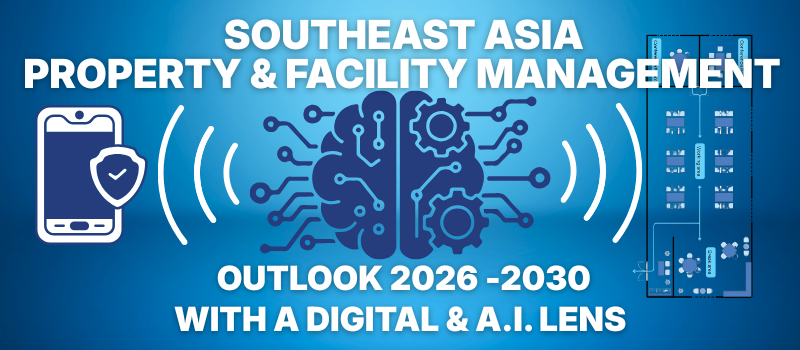
Southeast Asia Property & Facility Management Outlook 2025–2030 with a Digital and AI Lens
From the 1950s Southeast Asia’s Property and Facility Management (PFM) industry has always reflected the region’s growth story. Recent PFM outlook reports show that in the next five years the industry will shift from manpower‑heavy, cost‑pressed delivery toward intelligent, data‑driven operations. What once was measured in headcount and price will then be defined by uptime, efficiency, sustainability, and user experience.
Sensors, AI, and integrated platforms are rewriting the rules of how assets are managed, how value is proven, and how resilience is built. Today, the question for every player in the ecosystem is no longer if digitalisation will reshape PFM, but where and what solutions will set the standard across Southeast Asia.
The SEA market for Property and Facility Management (PFM) is growing steadily, propelled by outsourcing, asset base expansion, higher tech acceptance, and strong sustainability demands.
The Singapore market grows slower than developing peers due to its advanced growth status and capped number of assets while the region’s overall outlook is for a wide and fast trajectory of expansion.
The past trend of in-house property management preferences, due to fragmented standards and high costs with uncertain quality, is shifting towards professional management teams with adopted digitalized tools satisfying the demand from MNCs and regulatory bodies.
Digital transformation is gaining momentum as IoT, data platforms, and analytics are becoming a standard as consolidated and multi-country PFM providers are adopting tech to satisfy mature end users seeking integrated value propositions.
Generative AI are moving from promise to practice in ASEAN as an integration priority to unlocking predictive maintenance, enabling energy optimization, and delivering service automation. Governments and enterprises are scaling infrastructure and strategies to accelerate AI adoption.
Market snapshot and structural dynamics
Size, growth, and segmentation
As showed by a TechSci Report, SEA FM revenue has hit USD85.16 billion in 2024 with a forecasted growth to USD118.82 with a CAGR of 5.55%through 2030. This growth is stronger in developing markets such as Indonesia, Thailand, and others while Singapore’s rate is lower due to market maturity.

Service mix
The Mordor Intelligence report “Asia Pacific Facility Management Market Size & Share Analysis - Growth Trends and Forecast (2026 - 2031)” has identified the main areas of growth being Hard FM (M&E, HVAC, fire safety, building systems) and Additional services (Environmental waste/recycling, IT/telecom, space planning/relocation) as the segments where tech enablement is rising fastest.
Demand drivers and restraints
Outsourcing expansion, evolving customer expectations, sustainability standards, and the rise of data-driven building operations remain the main growth drivers for the industry while cost control (outsource is still perceived as added-cost with loss of control), lack of industry benchmarks (generating inconsistent quality of deliverables) and, talent and wages pressure (low availability and retention issues for blue-collar staff) are the main restraints to a faster growth.
However, the above restraints are acting as additional push for PFM service providers to accelerate their digitalization and technology-supported solutions adoption.
Digitalisation trends reshaping FM
“From manual coordination to systems of insight” seems to be, as quoted in a recent Frost & Sullivan article, the trend of the PFM industry for 2026 and upcoming years. This will boost a wide adoption of IoT + data platforms to feed unified dashboards for uptime, energy, safety, and occupancy while turning daily operations into measurable KPIs.

Additionally, regional players are integrating analytics and real-time monitoring to meet mature end-user expectations. Most SEA governments and MNCs are raising their demand for smart, energy-efficient buildings.
Regional green agendas and evolving standards foster demand for energy analytics, optimization, and compliance, ESG and more, reporting.
Larger PFM service providers are partnering with scaling-up tech vendors to deliver integrated, multi-country offerings that blend hard/soft services with digital modules and greater SLA transparency.
Property developers and asset owners’ CIOs across ASEAN have highlighted how digital transformation delivers operational efficiency and net-zero progress, reinforcing market readiness for platforms that unify operations and sustainability data.
The AI opportunity in FM
Practical AI use-cases that convert cost to value
All industries are talking about AI integration and adoption, some forgetting that, before talking about Ai there should be a well-planned digital transformation completed journey. The International Facility Management Association (IFMA) has published an interesting article where, beside highlighting the above need, also lists the areas where AI integration would be more impactful.
Predictive maintenance
Ai integration will change the way equipment is maintained through precise forecast of failures (HVAC, pumps, lifts) and allow to scheduling interventions aiming to reduce downtime while extending asset life. Additionally, by combining sensor data with historical work orders AI will also help to prioritize maintenance crews and optimise spare parts’ inventory.

Energy optimization
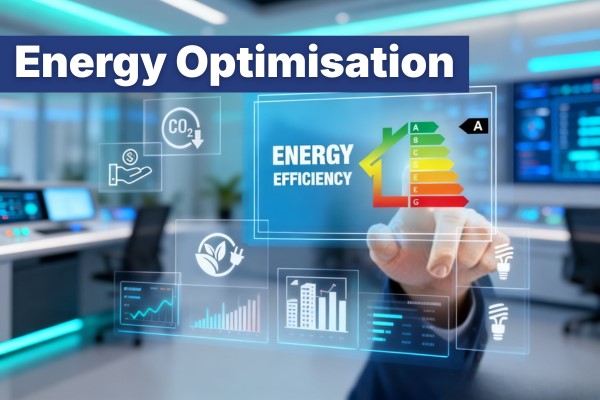
As the world moves towards net-zero target, AI-driven setpoint tuning, anomaly detection, and load forecasting can contribute to trimming kWh and demand charges without sacrificing comfort. With enough data collected the above will be easily integrating with sustainability reporting to substantiate ROI and savings to the asset owners.
Intelligent service desks
NLP-powered ticket triage, autofill, and knowledge retrieval, easily achievable with AI will reduce manual admin work, accelerate resolution of issues, and generally improve SLA performance. Furthermore, AI action agents will help triggering work-orders and control the respective workflows across Building Management Systems (BMS), Computer Aided Facility Management (CAFM), and procurement.

Why ASEAN is Primed and Why ServeDeck Matters
Across ASEAN, the momentum is undeniable. Young, digital‑native populations, rising data-center investments, and bold national AI strategies are positioning the region as a true frontier for developed and applied AI.
Malaysia has launched in 2025 the National AI Agency and is at the forefront of AI development and implementation, Thailand is openly pitching itself as an AI hub, while regional traffic convergence accelerates demand for smarter, more connected infrastructure.
The investment trajectory is equally clear. IMARC Group, in their 2025-2033 AI Regional Market Report, states that Southeast Asia’s AI sector surpassed USD 4 billion in 2024 and is expected to quadruple by 2033 to over USD17 billion with a CAGR of 16.59%.
This signals durable capital flows and ecosystem support for embedding AI into enterprise operations including property and facility management.
Countries’ adoption patterns highlight both opportunity and urgency:
-
Singapore, where the growth is slower, but expectations are the highest, sets the bar with stringent standards and analytics‑led facility management.
-
Malaysia, Thailand, Indonesia, Vietnam, and the Philippines are scaling faster, driven by expanding asset bases, regulatory pushes, MNCs influence, and cost pressures. Yet fragmented standards and in‑house preferences persist creating space for platforms that can standardize delivery, prove savings, and unify operations.
This is where ServeDeck steps in. By combining AI‑powered insights, rapid deployment, and seamless integration with BAS, IoT, and BIM, ServeDeck is uniquely positioned to help the ASEAN Property and Facility Management organizations elevating assets’ value, achieve operational efficiency, and gain competitive advantage.
As ASEAN primes itself for the next decade of digital transformation, ServeDeck is ready to be the partner that turns AI Integration plans into measurable and real industry outcomes.
ABOUT THE AUTHOR
The .jpeg) opinions expressed in this article are solely of the author, Dr Daniele Gambero.
opinions expressed in this article are solely of the author, Dr Daniele Gambero.
Dr Gambero has been an expatriate to Malaysia from Italy, since 1998 and has more than 35 years of real estate experience. He is the co-founder and group CEO of REI Group of Companies, the Co-founder of Propenomy.com and the president of the Malaysia Proptech Association.
In the past 10 years Daniele, as international and TEDX speaker, has engaged several hundreds thousand people talking about Property, Economy, Propenomy, Digital Marketing and Motivation. He is also a bestselling author and columnist on several magazines and main stream media. You can reach him directly through his LinkedIn page here.
SHARE THIS POST:
Comments (0)
Leave a Reply
Your email address will not be published. Required fields are marked *